
Revision & Secondary Rhinoplasty in Hyderabad
Fixing Unsatisfactory Rhinoplasty Results with Functional + Aesthetic Expertise
When a previous nose surgery fails to deliver your desired appearance—or creates new breathing difficulties—Revision Rhinoplasty provides a path to structural restoration. Re-operating on the nose requires a rare level of micro-surgical mastery to safely repair compromised tissue.
At Microcare ENT Hospital & Research Institute, our ENT-led rhinoplasty team specializes in complex secondary reconstructions. We rebuild the nasal architecture from the inside out, simultaneously resolving severe structural defects, aesthetic deformities, and airway blockages left behind by prior surgeries.
India's Top Rhinoplasty Surgeon

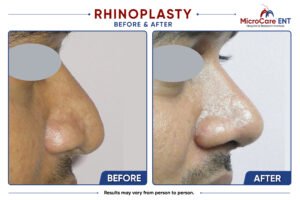
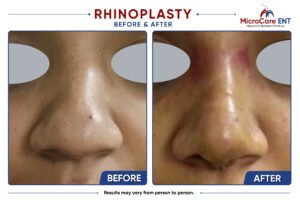
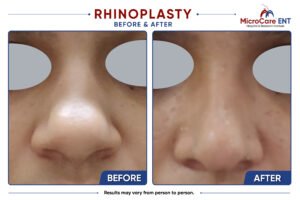
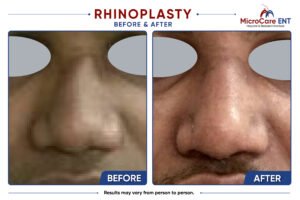
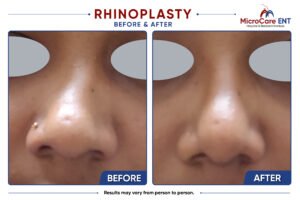
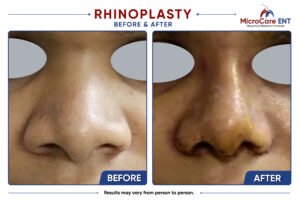
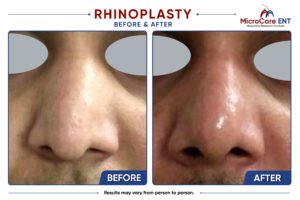
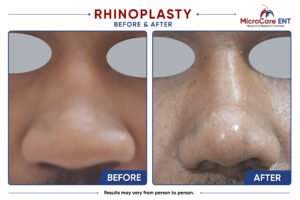
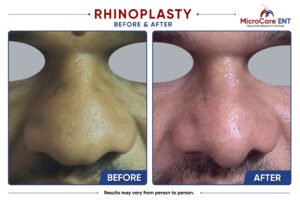
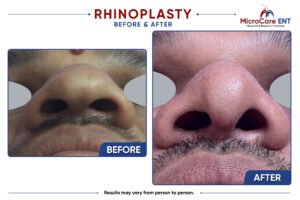
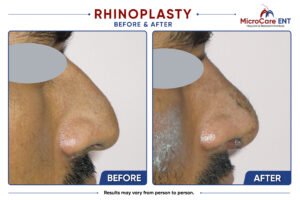
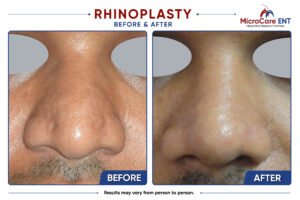
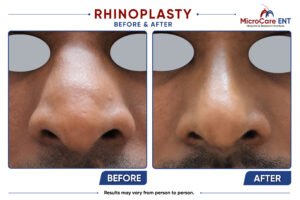
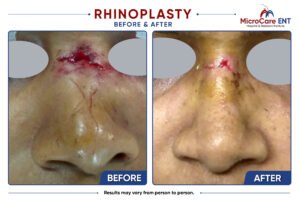
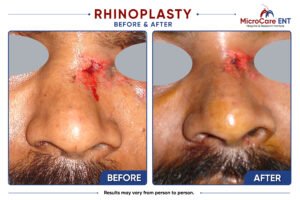
What Is Revision Rhinoplasty?
What Is Revision Rhinoplasty?
Revision rhinoplasty (also classified as secondary rhinoplasty) is a corrective surgical procedure performed to rectify issues resulting from a previous nose job. It is widely recognized as the most challenging sub-speciality in plastic and reconstructive surgery.
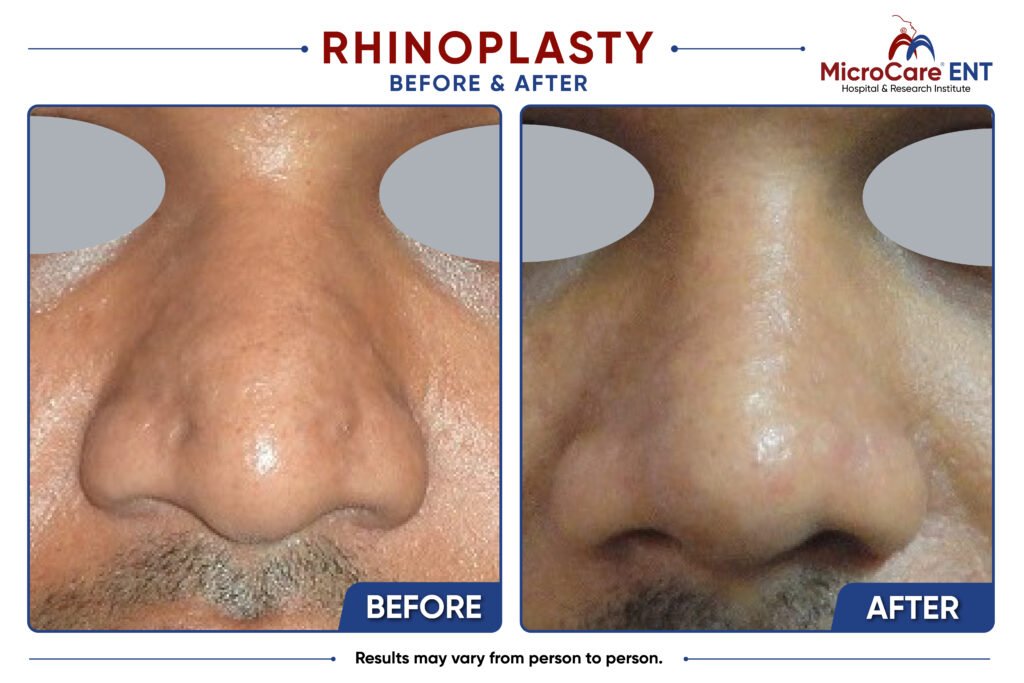
Patients turn to our Centre for Advanced Rhinoplasty in Hyderabad to correct severe post-surgical complications, including:
- Persistent Nasal Asymmetry: A nose that remains tilted, twisted, or unaligned with the facial midline.
- Iatrogenic Airway Obstruction: New or worsened breathing difficulties caused by internal structural collapse.
- Saddle Nose Deformity: A sunken, collapsed nasal bridge resulting from over-resection of supporting cartilage.
- The "Pinched" Tip Deformity: An unnatural, sharp tip that constricts the nostrils and chokes airflow.
- Severe Regressive Drooping: A loss of tip projection that causes the nose to sag dynamically when smiling.
Why Revision Rhinoplasty Demands Specialized Expertise
A secondary nose surgery cannot be approached like a primary procedure. Every prior operation alters the baseline anatomy, presenting the reconstructive surgeon with four major clinical hurdles:
- Scar Tissue Matrix: Distorts tissue planes; restricts skin envelope elasticity
- Structural Depletion: Missing septal cartilage requires alternative harvesting
- Correction of Congenital Deformities: Addressing birth-related nasal issues (such as cleft lip nasal deformities) to improve both form and function from an early age.
- Altered Airway Flux: Collapsed internal valves increase respiratory resistance
1. Navigating the Dense Scar Tissue Matrix
Prior surgical trauma replaces soft, predictable tissue planes with dense, fibrotic scar tissue. Navigating this matrix requires meticulous micro-dissection to prevent skin thinning, vascular compromise, or delayed dermal healing.
2. Correcting Severe Cartilage Depletion
During primary surgeries, excess septal cartilage is frequently removed. Revision cases often feature a “hollowed-out” or structurally bankrupt nose. To rebuild the framework, our surgeons utilize advanced autologous harvesting, safely sourcing living tissue from the ear (conchal cartilage) or rib (costal cartilage) to restore rigid support.
3. Reversing Internal Valve Collapse
When a nose is made smaller without reinforcing its structural gateways, the internal nasal valves weaken. This causes the nostrils to cave inward during normal inhalation. We use specialized structural grafts (such as spreader grafts or batten grafts) to permanently prop the airway open.
Common Post-Surgical Deformities We Correct
- The Over-Resected Nose: Occurs when too much bone or cartilage was removed, creating an artificial, "scooped-out" ski-slope appearance that lacks harmony.
- Persistent Dorsal Irregularities: Residual bony humps, asymmetrical ridges, or sharp edges that cause uneven shadows under frontal lighting.
- Alar Retraction & Notch Deformities: Nostrils that have pulled upward abnormally, exposing too much of the internal nasal lining.
- The Pollybeak Deformity: A structural mismatch where the area just above the tip remains humped, making the nose resemble a bird's beak.
Our Functional + Aesthetic Reconstructive Protocol
At Microcare, your secondary surgery is guided by a strict, multi-layered clinical protocol designed to deliver permanent stability:
- Structural Re-Engineering: We do not rely on temporary cosmetic camouflages. We systematically rebuild the nasal scaffolding using your body's own tissue.
- Airway Optimization: Every visual alteration is cross-checked against internal airflow dynamics using high-definition diagnostic nasal endoscopy.
- Craniofacial Proportionality Alignment: We restore balance by calculating the precise angles between your forehead, lips, and newly projected bridge.
- Long-Term Framework Stability: We anchor structural grafts using ultra-fine microsutures to guarantee the nose maintains its shape, tracking safely through the natural aging process.
Are You an Ideal Candidate for a Secondary Procedure?
You may benefit from a Revision Septorhinoplasty at our Hyderabad institute if:
- You are deeply dissatisfied with the visual or functional outcome of a past nose surgery.
- Crucial Timing: At least 12 full months have passed since your last rhinoplasty. It takes a year for deep scar tissue to soften and for swelling to resolve completely before a revision can be safely executed.
The Revision Recovery & Tonal Refinement Timeline
Because a secondary procedure involves working through pre-existing scar tissue, the body requires a more gradual, disciplined healing phase:
Phase | What Happens to Your Nose | Clinical Instructions |
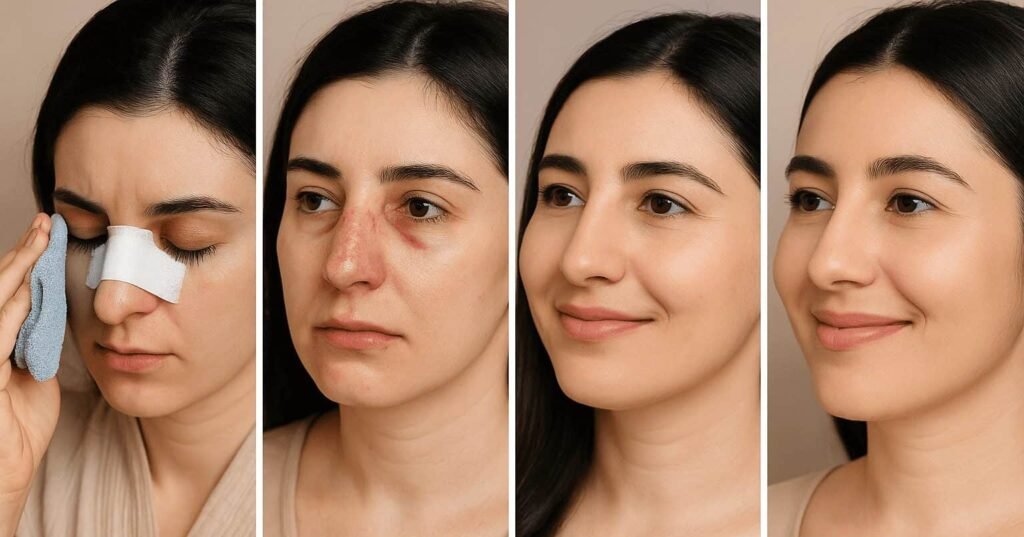
Week 1 | External splint stabilization; initial swelling mimics a dense sinus cold. | Splint and microscopic sutures are removed on Day 7 at our hospital. |
Weeks 2–3 | Bruising dissipates; the nose becomes socially presentable for daily routines. | Avoid wearing heavy eyeglasses directly on the reconstructed bridge. |
Weeks 6–12 | Deep inflammatory fluid drains; the refined contours of the bridge emerge. | Light physical cardio may resume; avoid all contact sports. |
Months 6–12+ | The skin envelope fully contracts over the new, permanent cartilage grafts. | Final structural definition and maximum airway clearance are achieved. |
Revision Rhinoplasty Cost in Hyderabad
The financial investment for a Secondary Nose Job in Hyderabad is highly individualized and cannot be quoted as a flat package. The cost is calculated based on the following precise variables:
- The total surgical time required to meticulously dissect through dense internal scar tissue.
- The volume and source of grafting required (Primary septum vs. advanced Rib/Ear cartilage harvesting).
- The severity of the structural deficit or airway collapse.
- Whether the procedure requires complex multi-planar osteotomies.

Dr. Sriprakash Vinnakota
MS ENT, HEAD & NECK
CHIEF RHINOPLASTY SURGEON
26+ years of Experience
The ENT Advantage: Why Specialized Expertise Matters in Rhinoplasty
A successful rhinoplasty must achieve a delicate equilibrium between form and function. Because the nose is primarily a complex respiratory organ, the specialized training of an ENT (Otolaryngology) Surgeon provides a distinct advantage in ensuring long-term surgical success.
A successful rhinoplasty must achieve a delicate equilibrium between form and function. Because the nose is primarily a complex respiratory organ, the specialized training of an ENT (Otolaryngology) Surgeon provides a distinct advantage in ensuring long-term surgical success.
At Microcare ENT, Center for Advanced Rhinoplasty & Functional Nose Surgery, our surgical philosophy is rooted in the following four pillars of ENT expertise:
Why Choose Microcare ENT Hospital for Your Revision Surgery?

- Master-Level ENT Experience: Led by Dr. Sriprakash Vinnakota, our chief surgeon brings over 26 years of advanced ENT microsurgical experience to complex reconstructive cases.
- Hospital-Grade Safety Infrastructure: We do not operate in makeshift boutique clinics. All secondary reconstructions are performed in fully equipped, NABH-compliant hospital operating theatres backed by senior anesthesiologists and 24/7 emergency care platforms.
- Advanced Revision Diagnostics: We utilize high-definition fiber-optic endoscopy and multi-planar CT scanning to view your internal anatomy before making an incision, leaving zero variables to chance.
- Bio-Harmonious Results: We prioritize autologous structural grafting, entirely avoiding foreign synthetic implants that carry high rates of long-term infection and extrusion in revision tissues.
Frequently Asked Questions (FAQs): Understanding Rhinoplasty
At Microcare ENT, Centre for Advanced Rhinoplasty & Functional Nose Surgery, we believe informed patients achieve the best surgical outcomes. Below are the most common queries regarding nasal reshaping and functional recovery.
1. Is rhinoplasty surgery permanent?
Yes, the structural changes made to the bone and cartilage during rhinoplasty are permanent. While your nose will continue to age naturally along with the rest of your face, the specific refinements achieved during surgery—such as a straightened bridge or a refined tip—are long-lasting. At an Advanced Super Speciality level, we use structural grafting techniques to ensure the nose maintains its shape and support for a lifetime.
2. Will rhinoplasty affect my breathing?
When performed by an ENT-led surgical team, rhinoplasty is designed to either preserve or significantly improve your breathing. In many cases, we perform a Septorhinoplasty, which simultaneously enhances the external appearance while correcting internal obstructions like a deviated septum. Our focus on the “Internal Nasal Valve” ensures that aesthetic beauty never compromises respiratory health.
3. How long does it take to see the final results of a "nose job"?
While the primary “surgical look” and bruising typically subside within 10 to 14 days, the final refinement is a gradual process.
- 1 Month: Approximately 70% of the swelling is gone.
- 3–6 Months: The bridge and mid-vault area reach their near-final shape.
- 12 Months: The nasal tip—which has the thickest skin—completes its final "shrink-wrap" and refinement.
4. Is the rhinoplasty procedure painful?
Most patients are surprised to find that rhinoplasty is not “painful” in the traditional sense, but rather involves a feeling of nasal congestion or “fullness” similar to a heavy cold. Post-operative discomfort is typically mild to moderate and is effectively managed with prescribed analgesics. At Microcare ENT, we utilize precision tools (like piezoelectric instruments) to minimize tissue trauma, which significantly reduces post-operative pain and swelling.
5. Can I wear glasses immediately after rhinoplasty?
During the first 4 to 6 weeks, patients should avoid resting heavy glasses or sunglasses directly on the nasal bridge, as this can affect the healing of the reshaped bone. Our team provides specialized advice on using “cheek-rests” or taping glasses to the forehead if corrective lenses are a medical necessity during early recovery.