
Separate the myths from the facts.
Much of what people hear about nose surgery is outdated or simply wrong. Here are the 12 myths patients mention most often, with the facts from our ENT rhinoplasty team, led by Prof. Dr. Sriprakash Vinnakota.
Rhinoplasty is only for cosmetic purposes.
Rhinoplasty can improve breathing as well as appearance. It corrects structural problems such as a deviated septum or collapsing valves, and many patients have both functional and cosmetic goals. Functional rhinoplasty
Only women have rhinoplasty.
Men and women both have rhinoplasty. The goals are different: men usually want a strong, straight bridge, so every plan is tailored to the person. Male rhinoplasty
Rhinoplasty always gives an obvious, operated look.
Modern rhinoplasty aims for subtle, natural results that suit your face. An overdone look comes from removing too much, which careful structural planning is designed to avoid.
Rhinoplasty is extremely painful.
Most patients describe pressure and a blocked feeling, like a heavy cold, for two to three days rather than severe pain. It is controlled with medicines.
Recovery takes forever.
Most people return to desk work or college in 7 to 10 days. Swelling then settles gradually, with the final shape appearing over 6 to 12 months.
Fillers can replace surgery.
Fillers can disguise a small bump for a while, but they are temporary, cannot make the nose smaller and cannot fix breathing. Filler in the nose also carries rare but serious risks. Hump correction
Rhinoplasty is unsafe.
Rhinoplasty is a well-established operation. In a hospital setting, with an experienced surgeon and anaesthesia team, serious complications are uncommon. Like any surgery it has risks, such as bleeding, infection or asymmetry, which are explained before you decide.
You can bring a celebrity photo and get that nose.
A nose that suits one face may not suit yours. Your plan is based on your own proportions, skin and anatomy, and on what is realistic.
Making the nose smaller always improves it.
Removing too much can weaken the nose, pinch the tip and cause breathing problems. Often the best result comes from reshaping and supporting, not just reducing.
The final result is visible as soon as the splint comes off.
You will see an improvement at about day 7, but the nose is still swollen. The tip in particular keeps refining for months.
Teenagers can never have rhinoplasty.
Cosmetic changes wait until the nose has finished growing, around 15 to 16 for girls and 17 to 18 for boys, but breathing problems and injuries can be treated earlier when needed. Rhinoplasty in youth
Insurance never covers rhinoplasty.
Purely cosmetic surgery is not covered, but the functional part, such as correcting a documented deviated septum or an injury, may be eligible for insurance or TPA cover. Cost and insurance
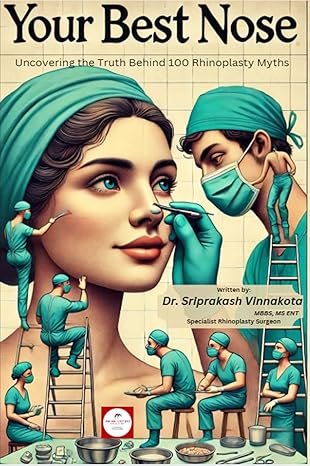
Your Best Nose
The Truth Behind 100 Rhinoplasty Myths
Prof. Dr. Sriprakash Vinnakota answers the hundred myths patients ask about most, in plain language, so you can make your decision with the facts in hand.
Begin with a conversation
Meet Prof. Dr. Sriprakash Vinnakota to talk about your nose, your breathing and what you would like to change. Every plan starts with a thorough assessment. Leave your name and number and we will open WhatsApp with your details filled in, or call +91 94949 40725.